
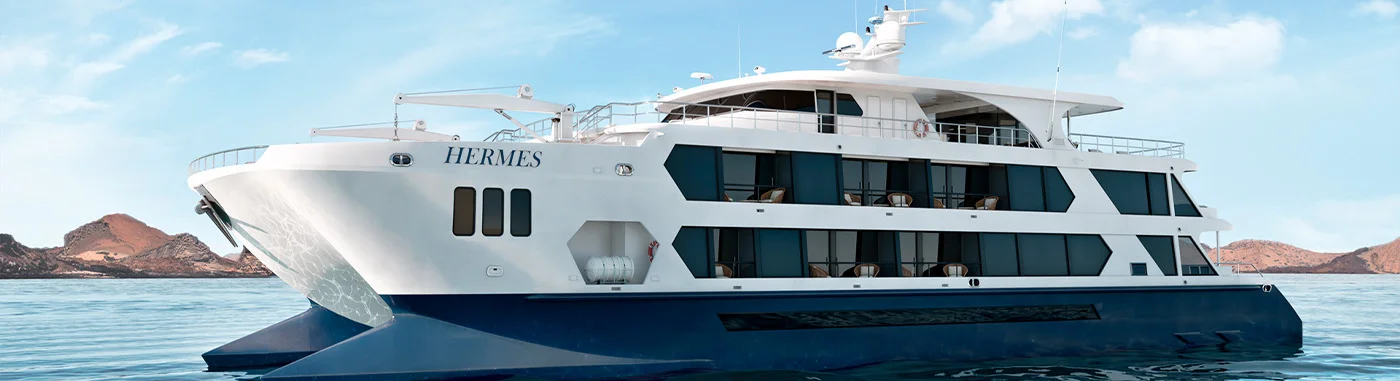
Every Galápagos booking site sorts its vessels into classes, but they vary from site to site. The Galápagos cruise classes become much easier to compare once you know their actual registered classes and which names are just for sales purposes. Here's a simple figure to start with. On the Voyagers’ listed boats, the Economy rate at the low end and the Luxury rate at the high end for an 8-day cruise differ by $12,296 [8][10]. Both of those trips take place within the same national park.
Direct Answer: Galápagos cruise classes reflect the comfort tiers of every boat. Ecuador's national tourism authority registers each boat with overnight cabins as Luxury, First Class, Tourist Class, or Economy Class [1]. Sellers will also add labels such as ‘Tourist Superior.’ Class determines your cabin, crew, and price. It does not affect the route, which is fixed for each boat [3].
Key Takeaways:
- Ecuador's national tourism authority registers boats with overnight cabins in four categories: Luxury Class, First Class, Tourist Class, and Economy Class.
- Tourist Superior, mid-range, and budget are seller labels; one boat can have different labels on different sites.
- Class affects the cabins, crew numbers, included gear, and price. The route is fixed for each boat regardless of its class.
- The Level 1 to 3 Naturalist Guides were replaced in 2016 by two Tourism Heritage Guide grades and an Adventure Guide.
- Starting rates go up with class, but the top three classes do overlap, so you'll need to compare both the boats and the labels.
- Most fares will omit the flights, the park entrance fee, the Transit Control Card, and tips.
Choose your route and trip length first, then compare boats by class, cabin category, and guide credentials.

Galapagos Cruise Classes at a Glance
There are four classes. The cabins, the crew, and the price all vary as you go up. The routes and the guide requirement remain the same.
The table compares the four Galápagos cruise classes. Cabin and guide details are taken from the boat pages that Voyagers publishes for each class [14], and the prices are the lowest 8-day naturalist cruise fares that you can find on the class pages (all prices are as of October 2026).
|
Class |
Cabins |
Guides |
Itinerary |
8-day rate from, per person |
|---|---|---|---|---|
|
Economy |
Bunks or upper and lower berths, private bathroom, air conditioning |
One bilingual guide per boat |
Fixed route assigned to the boat |
USD 2,199 |
|
Tourist Superior |
Bunks, twins or doubles, private bathroom |
One bilingual guide per boat |
Fixed route assigned to the boat |
USD 3,990 |
|
First Class |
Twin, double or king beds, catamaran cabins of 16 to 25 square meters, balconies on some upper decks |
One guide on 16-guest boats, two or three on a 36-guest yacht |
Fixed route assigned to the boat |
USD 4,900 |
|
Luxury |
Suites of 30 to 43 square meters, private balconies on most boats |
Two guides on a 20-guest yacht, six on a 100-guest ship |
Fixed route assigned to the boat |
USD 5,536 |
In the Itinerary column, you’ll see that every cell has the same answer. Ecuador's tourism regulations for the protected areas (Decreto Ejecutivo 827) stipulate that each tour operator is given a fixed annual itinerary. This means that the class of boat has no bearing on which islands you will see [3]. Two more things are consistent across the board. Private bathrooms are listed on the boat pages in all four classes [14], and Voyagers states that a licensed bilingual guide is on every excursion [11]. Most of the boat pages we looked at also list meals on board and guided visits as part of the fare [14].
You can filter all four classes by date and by trip length on the Voyagers Galapagos cruises page.

Who Sets Galápagos Cruise Categories?
The four categories are set through regulations issued by Ecuador's National Tourism Authority. Under Acuerdo Ministerial 2019-059 (a regulation issued by the Ministry of Tourism in December 2019), all tourist boats with overnight cabins on the islands are classified into one of four Galápagos cruise categories: Luxury, First Class, Tourist Class or Economy Class [1]. In Spanish, these are Lujo, Primera Clase, Clase Turista, and Clase Económica.
The requirements for each category are in the regulation’s annexes. The boat's registration certificate states its category, and the authority can inspect the boat to confirm its class [1]. "Tourist superior", "Mid range", and "Budget" aren't among the four categories. Those are seller descriptors, with agencies having their own definitions.
|
Label type |
Who sets it |
Names used |
Where you see it |
|---|---|---|---|
|
Registered category |
National tourism authority, under the 2019 regulation |
Luxury, First Class, Tourist Class, Economy Class |
The boat's tourism registration certificate |
|
Seller label |
Each agency or operator |
Luxury, first class, tourist superior, mid-range, tourist, economy, budget |
Booking sites and brochures |
This is why a 16-guest catamaran can be listed as 'tourist superior' on one site and 'first class' on another. Neither site is lying, as they are rating the same boat on different scales.
Looking at the seller labels is still the quickest way to shop, as they package cabin style, service, and price into a single word. If two sites are conflicting, check which category the boat is in on its tourism registration and go with that. The tourism authority determines a boat's registered category, while the Galápagos National Park Directorate must approve changes to its itinerary [3].

Galapagos Tourist Class vs First Class
First Class swaps the bunks for twin, double, or king beds and adds a shared space. Their price ranges can overlap.
What the sellers refer to as a Galápagos “tourist class cruise” actually covers two tiers at Voyagers: Economy and Tourist Superior. If you compare Galápagos tourist class with first class, the immediate difference lies in the cabin [14].
|
Feature |
Economy |
Tourist Superior |
First Class |
|---|---|---|---|
|
Beds |
Bunks, or a double with an upper berth |
Bunks or upper and lower berths on Fragata and Eden, twin or double lower berths on Angelito |
Twin, double or king, no bunks on the boats sampled |
|
Cabin size |
Not listed |
Not listed |
16 to 25 square meters on catamarans |
|
Snorkel gear |
Rental on Darwin |
Extra charge on Fragata at USD 25 to 35, included on Eden and Nemo III |
Included on Galaxy, Seaman Journey and Coral I and II |
|
Wetsuits |
Rental on Darwin and Floreana |
Rental on Eden and Nemo III |
Included on Galaxy, extra on Tip Top II and Seaman Journey |
|
Built or refit |
Darwin built 1995, refurbished 2012 |
Samba built 1966, Eden refurbished 2018 |
Coral I and II rebuilt 2004, Seaman Journey renovated 2016 |
The prices of “tourist class” and “first class” actually sit close together. The 8-day Tourist Superior and First Class rates are only $910 apart. The two ranges overlap, so you’ll need to check the boat along with the label. For the more expensive fare, the Voyagers’ class pages indicate more deck and lounge space, better food, and double cabins with ocean views [7].
The tradeoff: Around USD 4,000 gets you 8 days on a Tourist Superior boat. A similar amount covers five days on several First Class boats, such as Coral I and II from USD 3,472 or Seaman Journey from USD 3,885 [7][14]). If you're after more islands, then the Tourist Superior Galápagos cruises or the Economy Galápagos cruises are the way to go. If you're after a bit more room and a bit more bed space after a long hike, then the First Class Galápagos cruises are the better option.
Guide qualifications differ less between classes than you might expect. The section below explains why.

What a Luxury Class Galápagos Cruise Adds
Luxury adds the crew, private balconies, and suites. As always, the route remains the same.
A luxury class Galápagos cruise has more people and more private space. You can see the crew count as listed on a boat page for a 16-guest boat. There are 6 on Darwin in Economy, 8 on Tip Top II in First Class, and 10 on Endemic in Luxury [14].
|
Feature |
First Class |
Luxury |
|---|---|---|
|
Crew for 16 guests |
8 on Tip Top II and Galaxy |
10 on Endemic and Elite |
|
Private balcony |
Upper deck cabins on Tip Top II |
Every cabin on Endemic, Infinity, Petrel and Hermes |
|
Wetsuits |
Included on Galaxy |
Included on Elite, Infinity and Hermes |
|
On board staff |
Crew and guide |
A cruise manager on Petrel, two butlers and a cruise director on Hermes |
|
Ship choice |
Mostly 16-guest yachts and catamarans |
Mostly 16- to 20-guest yachts and catamarans, plus ships of up to 100 guests |
Beyond the table, Voyagers’ luxury class page lists stabilizers and a more robust build as factors for smoother sailing, as well as meals prepared by the chef on board [8]. Some of the fares cover more, too. Hermes, for example, includes the park entry, the Transit Control Card, and select alcohol [14].
Larger ships also add shared facilities. The Galápagos Legend (100-guest ship) has a pool and a glass-bottom boat [14].
The route still does not change. Voyagers states that both first-class and luxury cruises follow the same itineraries and see the same wildlife [12]. Therefore, luxury Galapagos cruises are ideal for those who consider their time on board as an important part of the trip. A honeymoon or anniversary couple is a perfect example [6].

Galapagos Cabin Categories by Class
Higher tiers have more cabin categories. When getting a quote, make sure to ask which cabin category is covered.
A boat's class defines the range. The boat’s cabin category reflects the kind of room you sleep in and how much you pay. The cabin categories in the Galápagos become progressively more varied the higher the class [14].
|
Class |
Cabin categories listed |
Example boat |
|---|---|---|
|
Economy |
One: Standard Double |
Darwin: 8 Standard Double cabins |
|
Tourist Superior |
One or two: Standard, Superior |
Nemo III: Standard and Superior cabins |
|
First Class |
Two or three: Standard, Standard Plus, Junior, Suite |
Seaman Journey: 6 Standard cabins (16 m² each) and 2 suites (25 m² each) |
|
Luxury |
Up to three: Standard Double, Suite, Single |
Petrel: 2 suites (43 m² each), 6 standard double cabins (30 m² each), and 1 single cabin (14 m²) |
|
Luxury, expedition ship |
Several, from Standard Interior to Balcony Suite |
Galapagos Legend: Cabins ranging from 11 to 43 m² |
One ship can offer a wide range of cabin sizes. On the Galápagos Legend, the smallest and largest cabins differ by 32 square meters.
Deck location matters, too. Eden's bunk cabins are on the lower deck, while Tip Top II's king cabins with balconies are on the upper deck. If you're looking for a single cabin on a Galápagos cruise, start with the luxury boats. Petrel, Endemic, and Elite each list one, while Hermes lists two.
Voyagers' rates vary by cabin category, season, and departure date [7]. When requesting a quote, ask which cabin category the price covers.

Galapagos Naturalist Guide Levels, Old and New
Former Naturalist Guide Levels I and II now correspond to Tourism Heritage Guide I, while former Level III corresponds to Tourism Heritage Guide II. Dive guides fall under the separate Adventure Guide category.
Galápagos naturalist guide classifications were changed in 2016. Ecuador's regulations replaced the old Levels I, II, and III with two Tourism Heritage Guide grades and a separate Adventure Guide category [2]. Because booking sites still use the old labels, here's how you can interpret them:
|
Old label |
Current credential |
English level in the rule |
Second language |
|---|---|---|---|
|
Naturalist Guide 1 |
Tourism heritage guide I |
B1 |
Not listed |
|
Naturalist Guide 2 |
Tourism heritage guide I |
B1 |
Not listed |
|
Naturalist Guide 3 |
Tourism heritage guide II |
B2 |
B1 |
|
Dive guide |
Adventure guide |
B2 |
Not listed |
The former Levels I and II have been merged into one grade. The clearest distinction between the two Tourism Heritage Guide grades is language proficiency. Grade I requires B1 English (intermediate), while Grade II requires B2 English (upper intermediate) plus a second language at B1 [2]. The Ecuadorian national environmental authority issues the credentials [2].
How does this relate to cruise class? Voyagers lists Level II and III guides on Luxury and First Class boats, and Level II guides on Mid-range and Economy boats [11]. Mid-range is another name for Tourist Superior [9]. Under the current system, this translates to Tourism Heritage Guide Grades I or II on Luxury and First Class boats, and Grade I on Mid-range and Economy boats.
Guide labels only tell you so much. Before booking, ask who will guide your departure, which credential they hold, and which languages they speak.
Do Galapagos Itineraries Change by Cruise Class?
Cruise class doesn't determine the route. The boat's assigned itinerary and trip length dictate what you get to see.
A route belongs to the boat. It does not rely on its class. Each boat follows its assigned itinerary, regardless of whether it's Luxury, First Class, Mid-range, or Economy. And there are two other factors that determine which sites you get to visit.
|
Your choice |
What it changes |
|---|---|
|
Route region |
Which islands and wildlife you see |
|
Trip length |
How many islands you reach |
|
Class |
Cabin, service and price |
Voyagers recommends starting with the region. Western routes for flightless cormorants and Galápagos penguins, eastern routes for waved albatrosses from April to December, and northern routes for divers hoping to see hammerhead sharks [6].
Next, consider trip length. A 4-day cruise gives you around two full days of sightseeing, as the first and last days are mostly taken up by travel [7]. Voyagers recommends at least 8 days to explore the archipelago's different regions [6].
Choose your route and trip length first, then select the cruise class that suits your budget for your preferred dates.

Galapagos Cruise Class Prices for an 8 Day Trip
Cruise prices vary widely within each class, with the top three classes overlapping.
There is more to the labels. These are the lowest and highest per-person starting rates listed by Voyagers for 8-day naturalist cruises, as checked in October 2026. Dive trips and day boats are excluded.
|
Class |
8-day rate from |
Highest starting rate |
Boats at each end |
|---|---|---|---|
|
Economy |
USD 2,199 |
USD 3,190 |
Darwin, Golondrina [10] |
|
Tourist Superior |
USD 3,990 |
USD 6,967 |
Beagle, Archipel II [9] |
|
First Class |
USD 4,900 |
USD 7,484 |
Blue Spirit, Grand Daphne [7] |
|
Luxury |
USD 5,536 |
USD 14,495 |
Galapagos Legend, Hermes [8] |
The highest Tourist Superior rate exceeds the lowest First Class rate, and the highest First Class rate exceeds the lowest Luxury rate. In other words, the boat itself tells you more about the fare than its class label alone.
Most fares exclude four additional costs: flights from mainland Ecuador, the Galápagos National Park entrance fee of USD 200 per adult (USD 100 for children under 12), the USD 20 Transit Control Card issued by the Galápagos Governing Council, and tips [4][5][14]. For two adults, the park fees and transit cards add USD 440.
Treat these rates as starting points. Prices vary by season, cabin category, and departure date, so use the table as a guide and request a current quote for your preferred trip.

Which Galapagos Cruise Class Fits Your Trip?
Match the class to your travel style, then ask questions about the boat, the cabin, and the guide.
All four Galápagos cruise classes visit the same national park. The right one for you will depend on how you’d like your cruise to go.
|
If you want |
Start with |
|---|---|
|
The lowest fare, and can settle with basic cabins |
Economy |
|
Comfort and value in a private, air-conditioned cabin |
Tourist Superior |
|
A larger bed, more deck space and a small group |
First Class |
|
Suites, balconies and more crew per guest |
Luxury |
|
A steadier ride or room for a family |
A larger expedition ship or a catamaran |
Whichever class you may prefer, these three questions can help you compare quotes:
- Which category is the boat registered under for tourism?
- Which cabin category does the quoted rate cover?
- Who will guide the departure, and which credential do they hold?
A Voyagers advisor can compare boats across classes for your travel dates. Send your travel window, group size, budget, and preferred route, or call 1 949 682 7745 between 8 am and 6 pm ET, Monday to Friday.
Biggest real time availability of Galapagos cruises, over 1000 available departures in 2026, over 2000 available departures in 2027, 85 hand selected ships to choose from
Frequently Asked Questions
Do Economy Class Galapagos boats have private bathrooms?
Which Galápagos cruise class is best for families?
Which Galápagos cruise class is best if I get seasick?
What is the difference between a First-class ship and a Luxury ship in the Galapagos?
Is Tourist Superior an official Galápagos cruise class?
Are wetsuits and snorkel gear included in every class?
What level is the naturalist guide on a First Class Galapagos cruise?
How many Galápagos cruise classes are there?
Sources (14)
- Ministerio de Turismo del Ecuador – Reglamento de Embarcaciones de Transporte Turístico Marítimo en Galápagos, Art. 9 y 11 al 14 (2020)
- Ministerio de Turismo y Ministerio del Ambiente – Reglamento de Guianza Turística para Galápagos (2016)
- Presidencia de la República del Ecuador – Reglamento Especial de Turismo en Áreas Naturales Protegidas, Art. 38 (2016)
- Dirección del Parque Nacional Galápagos – Información de ingreso y tarifas de entrada a las islas (2024)
- Consejo de Gobierno de Galápagos – Preguntas frecuentes sobre la Tarjeta de Control de Tránsito (TCT)
- Voyagers Travel – Galapagos Cruises 2026 and 2027
- Voyagers Travel – Galapagos First Class Cruises
- Voyagers Travel – Galapagos Luxury Cruises
- Voyagers Travel – Galapagos Tourist Superior Class Cruises
- Voyagers Travel – Galapagos Economy Class Cruises
- Voyagers Travel – What Level of Naturalist Guide Will Be Aboard the Boat and Do They Speak English?
- Voyagers Travel – What's the Difference Between First-Class and Luxury Galapagos Cruises?
- Voyagers Travel – Is First Class Suitable for Families?
- Voyagers Travel – Galapagos Cruise Fleet: Darwin, Golondrina, Floreana, Fragata, Eden, Angelito, Nemo III, Samba, Beagle, Archipel II, Tip Top II, Seaman Journey, Galaxy, Coral I and II, Blue Spirit, Grand Daphne, Endemic, Elite, Infinity, Petrel, Hermes and Galapagos Legend (2026)